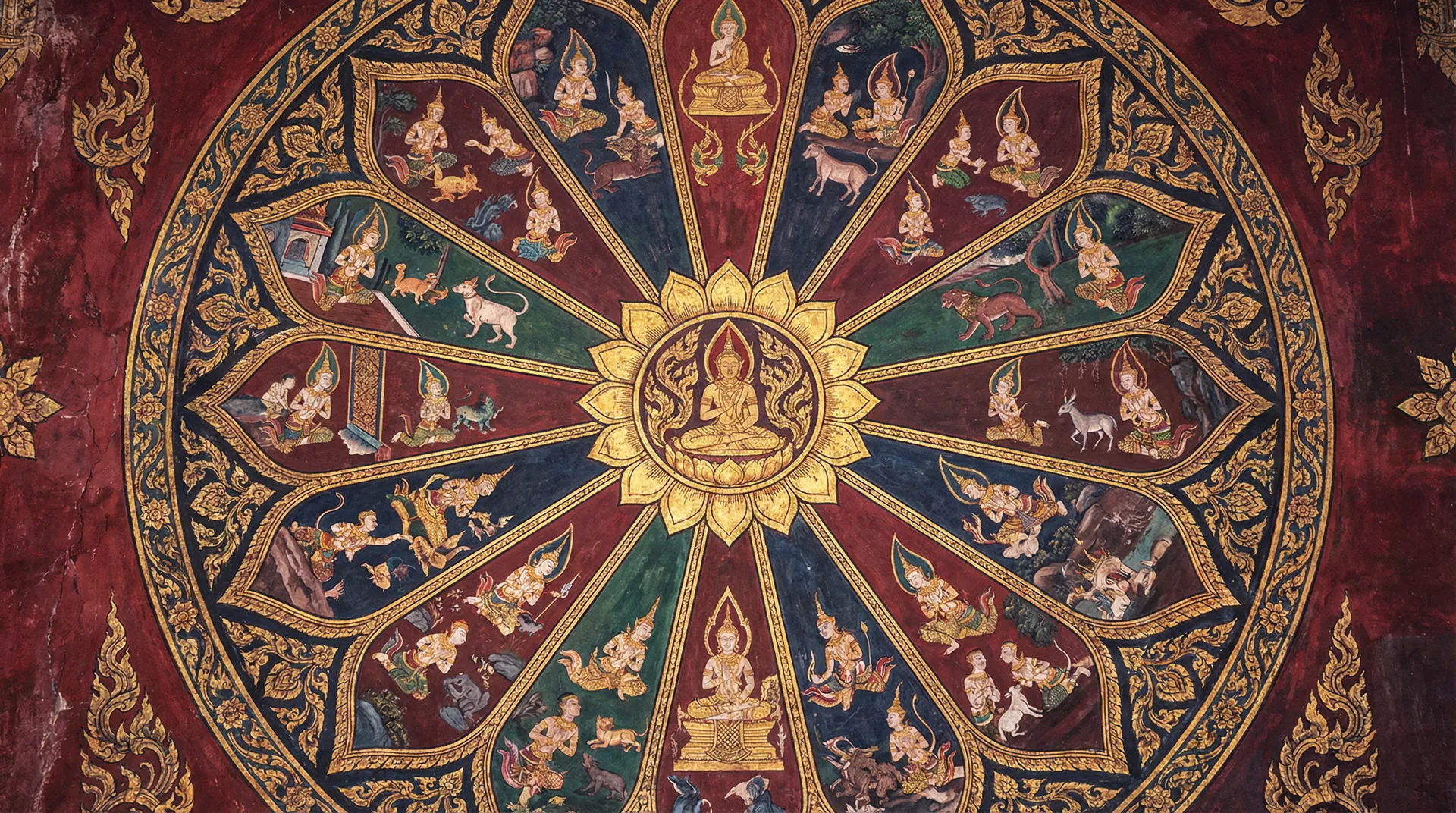
Bhuri Datta Jataka
The Serpent Prince's Noble Deeds
In the ancient kingdom of Kampila, nestled beside the mystical Himalayas, there lived a benevolent king named Bodhisattva. Unbeknownst to his subjects, the king was, in fact, a Nāga (serpent) prince, who had taken human form to experience life among mortals and to fulfill his spiritual aspirations. He was known for his wisdom, his compassion, and his unwavering adherence to the principles of righteousness.
One day, a powerful and wicked sorcerer, envious of the king’s virtue and his people’s prosperity, plotted to capture him. This sorcerer, skilled in dark arts, desired to harness the Nāga prince’s immense power for his own malevolent purposes. He concocted a potent sleeping potion, intending to drug the king and drag him back to the underworld of the Nāgas, where he could exploit his abilities.
The sorcerer, disguised as a humble Brahmin, approached the king while he was meditating in his royal gardens. He offered the king a special drink, claiming it was a sacred elixir that would enhance his spiritual focus. The unsuspecting king, ever trusting and mindful of the supposed sanctity of a Brahmin, accepted the drink and consumed it. As expected, the potent potion took effect, and the king fell into a deep, enchanted slumber.
The sorcerer, gleeful at his success, immediately began to perform his dark rituals, chanting incantations to transport the sleeping king. However, the king, though under the spell, was a Nāga prince of immense spiritual merit. His inherent purity and the good karma he had accumulated throughout his lives resisted the sorcerer's dark magic. The enchantment wavered, and the king began to stir.
As the king started to awaken, the sorcerer grew desperate. He intensified his chanting, but the Nāga prince’s innate power proved too strong. The sorcerer’s own dark magic began to backfire, ensnaring him instead. He found himself bound by his own spells, unable to move or escape, his body transforming into a giant, grotesque toad.
The king, now fully awake and seeing the sorcerer transformed into a toad, understood what had transpired. He saw the wickedness of the sorcerer’s intent and the power of his own virtue. Instead of retaliating with anger or punishment, the Nāga prince, guided by compassion, approached the trapped sorcerer.
'You sought to capture me,' the king said, his voice calm and resonant, 'but your own greed and malice have ensnared you. You have tasted the bitter fruit of your own actions.' He then used his spiritual power, not to harm, but to break the sorcerer’s self-inflicted curse, freeing him from his toad-like form.
However, the king did not let the sorcerer go without a lesson. He decreed that the sorcerer must now dedicate his life to repentance and good deeds, using his knowledge of the arts for the benefit of others, not for destruction. The sorcerer, humbled and ashamed by the king’s immense compassion and forgiveness, readily agreed. He renounced his wicked ways and spent the remainder of his days performing acts of kindness and service.
The Nāga prince, having thwarted the sorcerer’s plot and demonstrated the power of virtue and compassion, continued to rule Kampila with wisdom and justice. He showed his people that true strength lies not in power or conquest, but in righteousness, selflessness, and the ability to forgive even those who wish to do us harm. His reign was marked by peace and prosperity, a testament to the noble deeds of the serpent prince who walked among men.
— In-Article Ad —
💡Moral of the Story
True strength lies in virtue, compassion, and the ability to forgive. Malice and greed ultimately lead to one's own downfall.
Perfection: Compassion, Truthfulness, Wisdom
— Ad Space (728x90) —
More Jataka Tales You May Enjoy
 459Ekādasanipāta
Pāṇḍava Jātaka
Pāṇḍava JātakaIn a forgotten era, when the world was young and the gods walked among mortals, there ...
💡 Steadfast integrity, truthfulness, and unwavering loyalty are the strongest defenses against deceit and malice. Inner strength can overcome external threats.
 198Dukanipāta
Mahosadha Jātaka
The Tale of the Brilliant Sage MahosadhaIn the magnificent city of Mithila, there lived a Bodhisattv...
💡 True ownership is demonstrated through genuine care, responsibility, and concern for the well-being of what one possesses, rather than mere assertion of claim or possession.
 21Ekanipāta
The Bodhisatta as a Serpent
The Bodhisatta as a SerpentIn the cool, dark depths of a sacred cave, nestled within the shadow of t...
💡 The purest compassion, even at the cost of one's existence, can bring forth miraculous blessings.
80EkanipātaThe Tale of the Twin Elephants
The Tale of the Twin Elephants In the heart of the ancient kingdom of Mithila, where emerald forest...
💡 Laziness leads to downfall, while diligence, learning, and good deeds can lead to success and happiness.
59EkanipātaThe Tale of the Kassapa City Maiden
In the prosperous realm of Kosala, in days long past, there lay a small city named Kassapa. This cit...
💡 True intentions are often revealed through actions, not words. Observe closely, for the subtlest signs can uncover the deepest truths.
243DukanipātaMasa Jataka
Masa JatakaIn the bustling city of Varanasi, where the Ganges flowed like a silver ribbon and the ma...
💡 True wealth is not in accumulation, but in the boundless joy and merit derived from generosity and compassion.
— Multiplex Ad —